May 11th - May 16th
Monday, May 11th, 2026: I’m officially done with the writing portion of my Distinction paper!! All that’s left to do is add the images to my paper, write captions/figures for them, and properly format them. So far, I’m 14 pages WITHOUT images, so I’m not worried about the 15-30 page count anymore, haha. I guess I had a lot to say.
Wednesday, May 13th, 2026: The show is tomorrow! The only thing I had to do was retrieve my pedestal from the gallery and move it upstairs. Another thing completed was uploading all the images to the paper, except those to be taken on May 14th during the show. Which means my paper is 98% done! YAY! All that is left to do tomorrow is to set up for the installation and print a brief description of the work, since I’ll be floating around both on the main floor and upstairs.
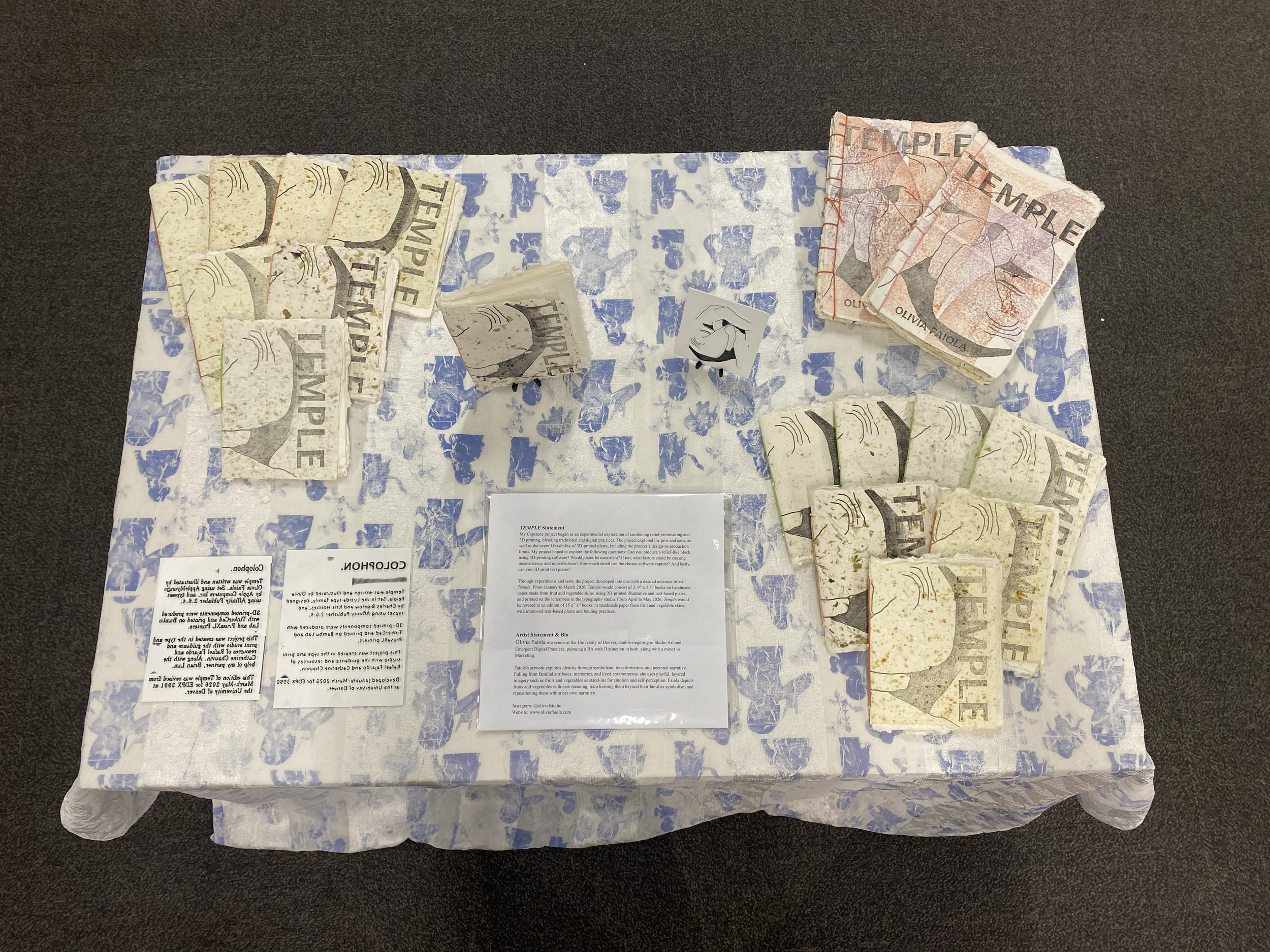
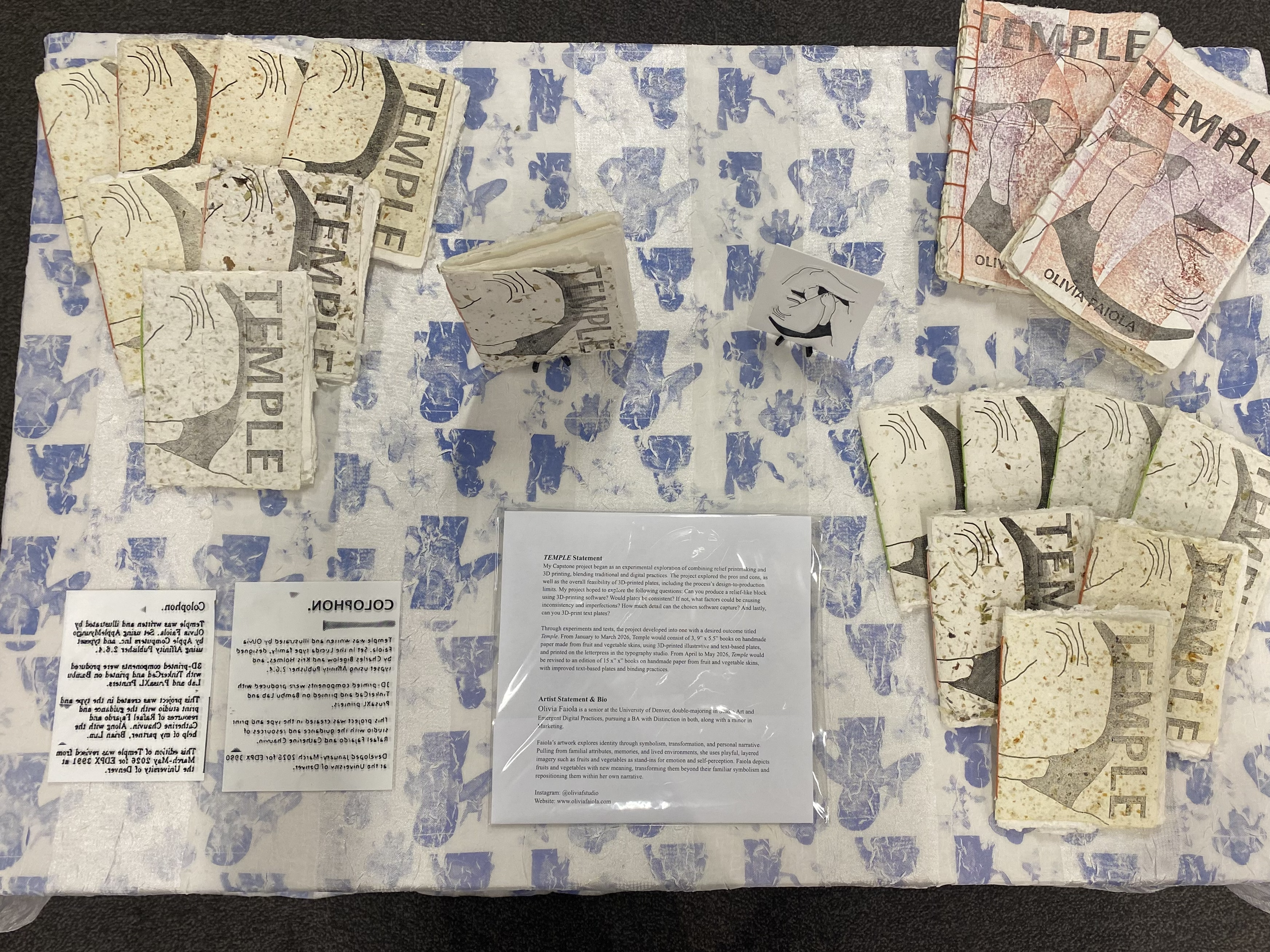
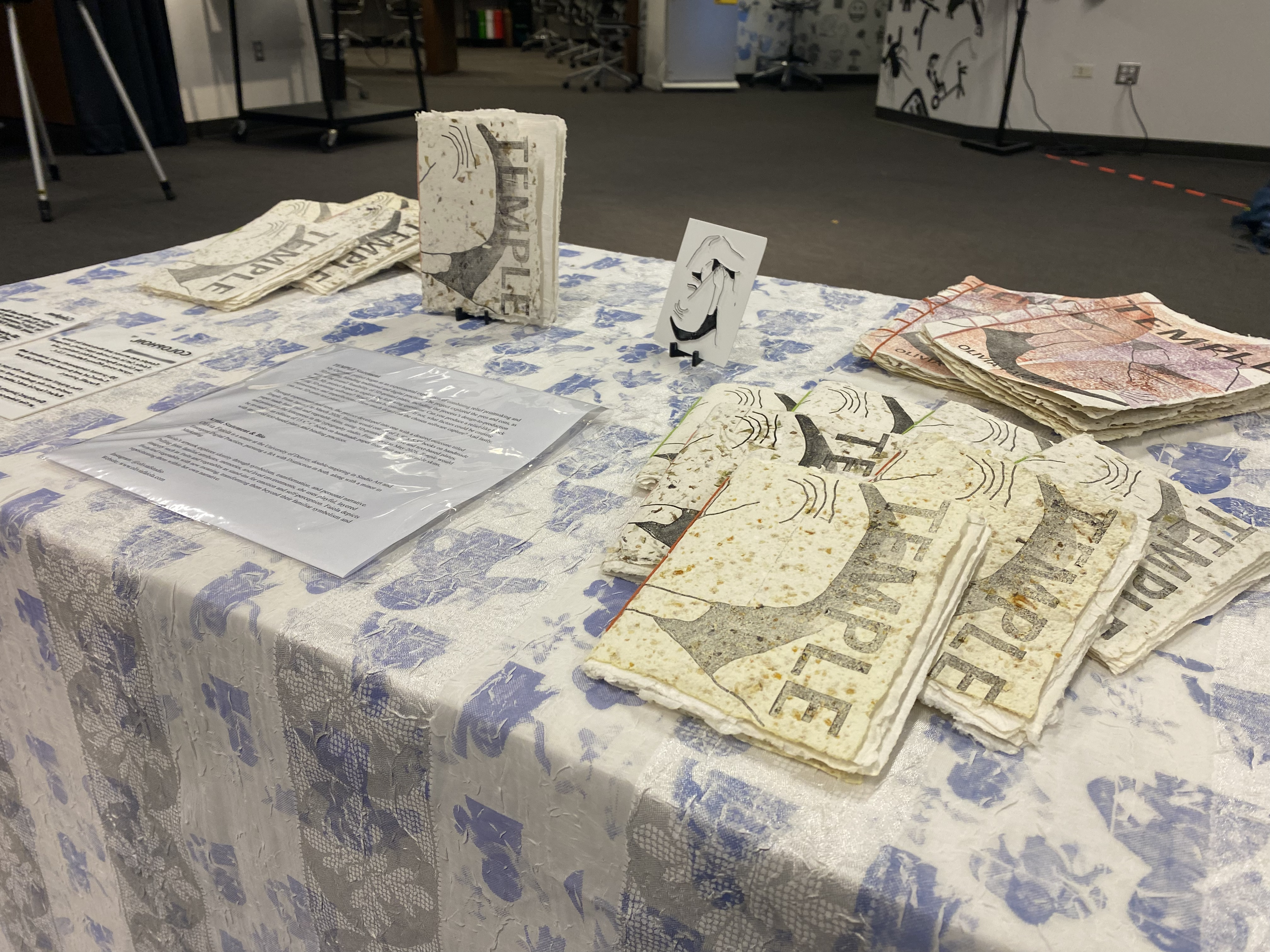
Thursday, May 14th, 2026: THE SHOW WAS TODAY! What an amazing experience to show my friends and loved ones what I’ve been working on this school year. Thank you to my professor and Independent Study mentor, Rafael Fajardo, for encouraging and motivating me and this project! Temple is officially completed!
May 4th - May 9th
Monday, May 4th, 2026: Rafael and I had pushed our meetings to Wednesday, so I have a little more time to prep for our next meeting, since last week, the only progress I made was binding. So today, I’m pulling the remaining cover pages! Luckily for me, past me had kept unused paper pulp from previous batches. Meaning, the only prep I needed to do was to soften the pulp balls in hot water for ~30 minutes, or until the fibers had broken down enough that it was soft and… not to use food/meat terminology, but basically “falling off the bone.” Once it’s soft enough, I blend it at a 1:2 ratio (1 part pulp, 2 parts water) until it's further broken down. Then I can pull the paper like normal!
However, I do wish I had kept track of which pulp was used for which fruit or vegetable, especially which one was used for my capstone pages last quarter, and which pulp was saved for my studio art distinction projects. The easiest one to tell apart from the rest is the orange peel paper, 1) by the color and 2) by the scent! I was able to pull 3 sheets using the remainder of the pulp. Then I used 3 sheets of my grape and edamame pulp, which came from my studio art distinction, whoops! I don’t think it changes “Temple” too much, in my opinion. I was hoping to be consistent with the fruit and vegetables that appear in “Temple,” but that was more a matter of personal preference, if anything. Who knows if anyone would notice, other than those who read the blog and see the show, I guess, haha. Then for the remaining 2 sheets, I pulled leftover edamame pulp. So, in total, I got the remaining 8 sheets of paper today!
My goal tomorrow is to have all my sheets dry so I can print the covers on the letterpress! This will require three passes through the press with all-black ink, so it should go by quickly. I’m predicting an hour. Today, I’m also starting the 15-30 page paper required for EDPX distinction regarding the step-by-step process of “Temple.” According to the rubric, my paper needs approximately 11 sections, some of which are shorter than others! From today to May 17th (when it’s due), I have approximately 13 days to finish the paper! I’m planning to do at least one section a day so that my paper can hopefully be completed by May 15th. Which is the day after the May 14th show. Fingers crossed lol.
Tuesday, May 5th, 2026: This morning, I finished printing the cover page of Temple across all 8 sheets! The process went by quickly, maybe 45 minutes tops of printing! I also started the paper yesterday and finished the project's introduction. I never realized how difficult it is to write about your project in a way that someone who doesn’t know your project understands. I’m hoping to get another section done today. I’m not going in chronological order with the sections; I'm picking one and writing about it. This helps me not feel too overwhelmed, not sure about the science behind it, if there’s any. Yesterday, I also thought it would be helpful for each section to include bullet points on the important info/topics to cover. Tomorrow, I’m installing with the Davis gallery, and I’m going to ask to borrow a pedestal for the expo upstairs (where Temple will be) to display my books. In my head, I have a vision for how I want it to look, but we’ll see what pedestals are available for me since I don’t want the surface area to be too small. Hopefully I can get my hands on one!
Thursday, May 7th, 2026: Yesterday was a snow day, so I wasn’t able to finish binding the remaining 8 books. And I meant to bind them today, but I grabbed everything I needed, except the bookbinding punching cradle! So tomorrow I will bind! Yesterday and today, however, I continued to make progress on the paper. Who knew writing the methods section would take so long! But the most complicated and long section is completed, and I have 6 sections remaining. Since the rest of my sections are mostly bullet-pointed and more reflective, I believe the majority of the paper will be completed over the weekend. When writing the methods section, however, I noticed how many images I needed to add to fully demonstrate how to do certain things (like binding or creating a book mockup). So I’m hoping to dedicate a day or two just to adding images to the paper alone.
Friday, May 8th, 2026: I officially finished binding the books! For the rest of the weekend and leading up to the 14th show, I’m going to continue working on my distinction paper and gathering materials for the new Temple installation.
April 27th - May 2nd
Friday, May 1st, 2026: Full transparency: there was not much progress made this week on “Temple.” Originally, I had hoped to finish pulling the remaining 8 fruit and vegetable papers; however, progress stalled as I finished my tufting pieces for the upcoming gallery show, which needed to be dropped off and finished by May 5th. So that set of projects took higher priority, as my deadline was tighter and the scale was massive. However, I felt guilty for not working on my capstone project, but was reassured by peers that a lot of progress was made last week, and that after things are delivered, I’ll be able to dedicate all of my time to the capstone. Which was reassuring!
Saturday, May 2nd, 2026: I did make a little bit of progress! Yesterday, I picked up a 3D-printed bookbinding punching cradle from the type studio, which Rafael kindly printed for me on Monday! I was able to give it a try by starting the binding step on the 7 books that had printed covers. The stitching I used wasn’t anything special, and the process was similar to the stitching done on “Temple’s” first version, but I used the 3-hole stitch since the newer version is smaller in scale. Now, I’m officially done with 7 books, 4 orange paper, and 3 edamame paper! As I was binding the pages, I was thinking about how it would be displayed during the May 14th show, since I hadn’t given it much consideration. But when the show gets closer, I'll be able to figure it out.
After binding all of the books, though, I was proud to see it fully come together! At the start of Week 1 for the Independent Study, I wasn’t sure if my revision would be enough to transform “Temple.” However, with all the minor changes I made for the second version, I do feel like there’s a big improvement. Both by feel and appearance!
April 20th - April 25th
Tuesday, April 21st, 2026: Today, I went to the type studio to print two layers for “Temple.” I printed the two illustrative plates of the apple body and the core. Over the weekend, I attempted to print the illustrative plate with the text included to avoid running the paper through the press twice. While the print turned out great and would work, in theory, the font size was smaller than the text I’ve been using. Which meant I would eventually double-print the Apple pages, one day for the illustration and the next day for the text. Today, I only printed the two apples, especially since they used the same red color ink.
Wednesday, April 22nd, 2026: I continued printing the apple pages, this time adding the text to it.
Thursday, April 23rd, 2026: Same old same old, lol. This time, more progress! I finished printing one of the apple pages (pg. 4 on the mockup), which required 3 passes through the press: one for the illustration and the last two for the text. This one required more time through the press since I wanted the text to overlap with the illustration. Since I had the black ink out, I printed the text for pages 8 and 9 (the center pages). Then printed the illustration on the 7 fruit/vegetable paper I found last week. Tomorrow, hopefully, I will print the edamame on the center page along with the “Temple” title and the colophon page. Then, in theory, over the weekend, they’ll be dried, and I will be able to start binding and completing 7 books!
Friday, April 24th, 2026: I finished printing!! Or at least finished printing the pages for 7 total books! Printing took a little longer because, for the center pages (8-9), I changed the illustration of the edamame at the last minute. Instead of printing the same thing as the first version of “Temple,” I decided to reuse the 3D plate and double-print the opened edamame shell, instead of one edamame shell and the whole edamame. I did this instead because someone told me the whole edamame looked like a pickle. So I just reused the opened edamame illustration twice, which meant the center page had gone through the letterpress four times. Once for the sweet potato and text (7 and 10). Three times for the edamame images (2) and the text (1). The edamame page was also probably the only time I had to be more mindful of my registration, but even then, I wasn’t super precise/particular about it compared to other printmaking projects I’ve done. Then, I printed the “Temple” title and the colophon on the 7 fruit/vegetable pages!
During Week 5, I’m hoping to pull the remaining 8 produce papers, let them dry, and wrap up printing! I’ll also start binding the 7 completed “Temples” throughout Week 5. In my original plan, I wanted to start the Distinction paper; however, given how close I am to completing the set editions, I might use Week 5 to start a rough draft, and Week 6-Week 7 will be focused more on the paper.
April 13th - April 18th
Monday, April 13th, 2026 & Tuesday, April 14th, 2026: On Monday, aside from the routine check-in with Rafael, I officially finished pulling all 45 plain sheets of handmade paper! With them all dried at the start of Week 3, I was able to flatten all the pages together using the bookpress in the printmaking studio. On Tuesday, I went to the type studio to measure the sizes of my illustrative plates to see which designs needed to be reprinted on the 3D printer. However, to my pleasant surprise, all of the illustrative plates were the perfect size for the smaller editions of “Temple.” Meaning the only thing I needed to reprint was all the text 3D-plates. Also, within the type studio, I found extra sheets of edamame and orange peel paper (not printed on) tucked away! With both the surprises of the reprinting of 3D-plates being minimal and finding 7/15 produce paper, my anticipated workload for this project seemed to have shortened. Which was relieving on its own.
Wednesday, April 15th, 2026: Since I didn’t have to reprint any illustrative plates, I went into Affinity Publisher to revise the text. My first attempt wasn’t the best. I used Google Docs, Times New Roman, and had to do a few extra steps to just get my Doc turned into an SVG, then transferred into TinkerCad. For my first attempt, I wanted to use Times New Roman, 12 pt. However, the various “translations” of the text had been warped, and the 3D-printed plate had looked like gibberish. The main points of “error” were where the serifs of the text looked like the filament had blurred together the tiniest details. On the second attempt, I used the Lucida Sans font, and it printed out much better! For the third go-round (today), I used Affinity Publisher and the Apple Myungjo font to revise both the “Temple” text and the colophon page. The first print was “Temple’s” text, and I was shocked that it took ~30 minutes. However, the outcome wasn’t what I wanted, as I had accidentally sized it too small, so the text’s original 12-pt font looked like it had shrunk. The second print queued up (before the result of the first print was unknown) was the Colophon. Luckily, when the print went through on the Prusa, it stated it was ~2-hour print, which was more consistent with how much I usually wait for these types of prints. The colophon would print out perfectly!
Thursday, April 16th, 2026: Today, I only reprinted the failed “Temple” text, which was resized properly.
Friday, April 17th, 20206: With all my plain handmade paper flattened and the 3D-plates printed out, I finally got started with the actual printing process on the letterpress. Today, I did pages 6 and 11 (see last week’s mock-up drawing) and 10 and 7. During the printing process, I realized one of my pages required text and illustration on the same page. In the past rendition of “Temple,” I double-printed the illustration and the text separately, but I wondered if I could combine them on the same plate and pass it once less. I drafted a sample of this on TinkerCad by copying one of my illustrative files, then importing an SVG of the text and putting it on the plate. Saturday, I’m hoping to print it on the BambuLab printer and see how it goes. My main concern is that the imported text's font size won’t match the rest of the text printed on Thursday.
~ Olivia
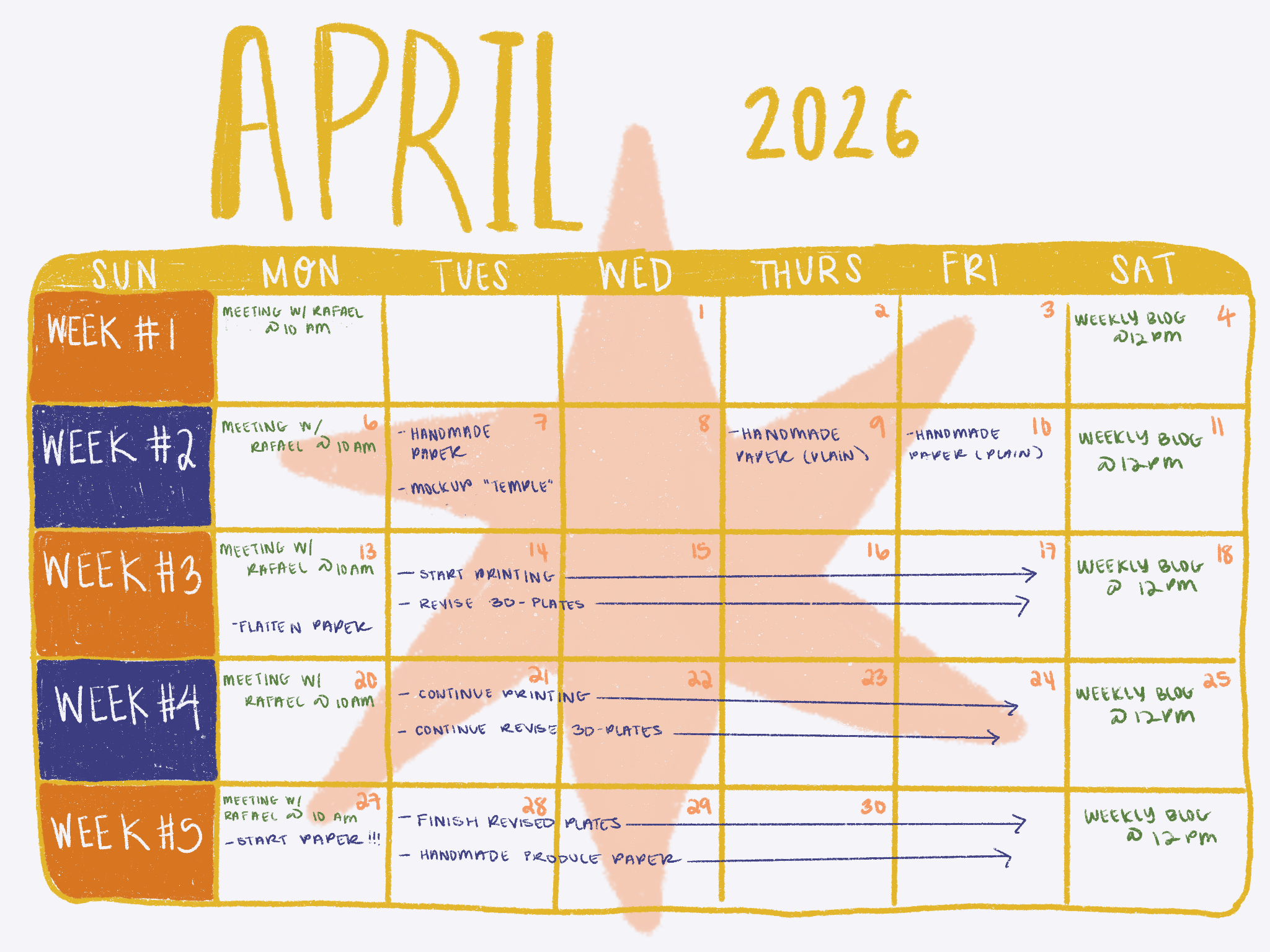
Tentative April Planner for “Temple”
April 6th - April 11th, 2026
Monday, April 6th, 2026: I had another meeting with Rafael to discuss the logistics of the revised version of “Temple.” Rafael seemed on board with the revision and pointed out some other things to consider. 1) Formatting of the “nesting” pages and the illustrations, 2) Pacing, and 3) Stitching.
Formatting of the “nesting” pages: This will be difficult to explain, so I’ll attach a drawing mock-up of what the pages would look like. The main point to explain is that instead of printing on the standard 5.5” x 9” sheets, I’m folding them in half, which will create two leaves or four pages in a book. Then every page will essentially “rest” on the others. Again, see the mock-up for a better explanation.
Pacing: The idea of pacing came up, and I really liked it! Skipping pages to create a “pause” before moving on to the next “beat.” Pacing is also discussed in the mock-up attached below.
Stitching: During our meeting, Rafael mentioned two stitch types to consider for “Temple”: Coptic binding and Smyth sewn. One of the differences I noticed is that coptic seems to be more common for DIY bookbinding, whereas smyth sewn is commonly used for manufacturing books. However, “Temple” has been scaled down and only requires 4 sheets of paper (more about that below), and, since it's soft-cover, I’ll be doing either a 3- or 5-hole pamphlet stitch.
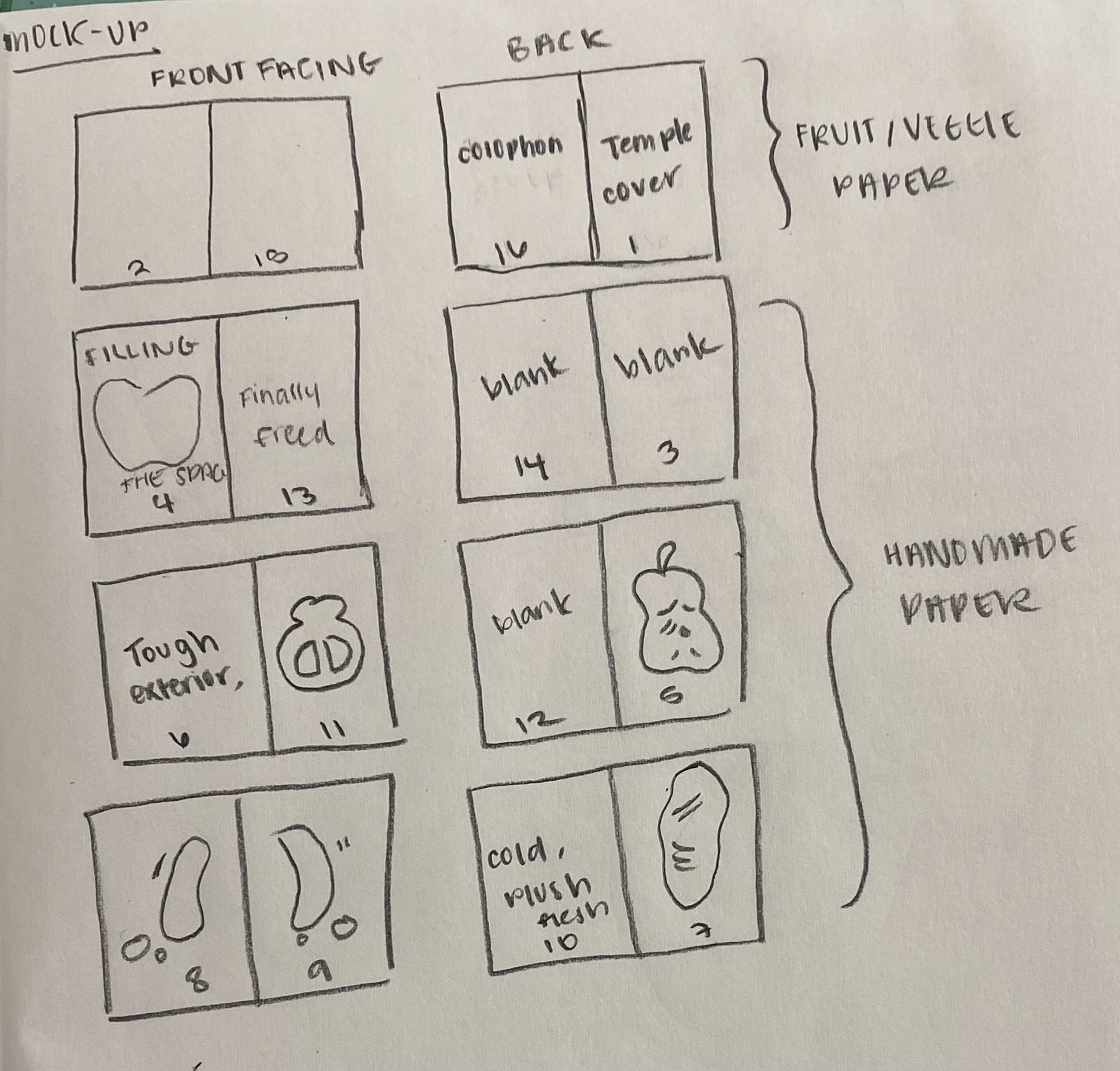
Tuesday, April 7th, 2026: Today, I worked on creating a proper mock-up to experiment with pacing and understanding how many handmade sheets I would need to pull. After finalizing the mock-up for “Temple,” I used 4 folded sheets of 5.5” x 9”, 1 sheet is the front and the back, which will be fruit/vegetable scraps, and the other 3 sheets are for the actual poem, using plain, handmade paper. 3 sheets of paper per 15 books is 45 sheets of handmade paper that need to be pulled, and 1 sheet per 15 books is 15 sheets of handmade paper WITH produce scraps. Adding all those numbers together for all 15 books of “Temple,” I’m pulling 60 sheets of handmade paper.
60 sheets is… a lot to pull. Which is why I got a head start today to figure out how many sheets I can pull in an hour and account for clean-up as well. In 45 minutes, I was able to pull 12 sheets of paper (using all the pulp in the vat that I prepared), and cleaning took approximately 10 minutes.
Thursday, April 9th, 2026: I continued pulling more sheets. However, today I was short by 1, so only 11 sheets. But that’s still progress! Currently, I have 23 sheets of paper, which is ~7 books. This means my remaining sheets that need to be pulled are 22 for plain handmade paper. I’m hoping to be done Sunday night or Monday morning, and all sheets will be dry. I’ll take them to the print studio to flatten for ~24 hours. That will allow me to pull the remaining sheets of fruit and vegetable paper next week.
Friday, April 10th, 2026: Today, I pulled 12 sheets, meaning there are only 10 sheets remaining that need to be pulled for the plain handmade paper. I also uploaded my April (tentative) calendar of things I hope to complete throughout the week. Of course, they’re subject to change, as things might be extended or shortened depending on schedules and timing. But I’m staying hopeful that the revised project can be done in time for the May 14th show. And I can show a comparison between the first version and the revised one.
~ Olivia
March 30th - April 3rd, 2026
Monday, March 30th, 2026, has marked my “first-last day” as an undergrad senior at the University of Denver. Despite convincing myself during Week 8 of the Winter term that I had already graduated, spring break has allowed me to relax and kick senioritis to the curb… I’ll try my best to overcome it as the weeks progress! As a refresher for those rejoining me after my final update regarding my Capstone, my project titled “Temple” combined printmaking and 3D printing to create a series of edition books/zines using 3D printed illustrations and text, along with using handmade paper. While I was happy with what I was able to accomplish within the 10-week timeframe, especially learning a whole new skill of 3D printing (which I barely think I touched the surface of, but I won’t go into a tangent), when I finally stepped back from the project, I realized there’s so much more I want to do. During the winter term, I discussed with my capstone professor, Rafael Fajardo, the possibility of completing an Independent Study to earn a BA with Distinction in Emergent Digital Practices. This involves a more self-directed approach, as there’s no set time or official class date for EDPX 3991, and expanding or creating new bodies of work, along with writing a paper.
As discussed previously, Mondays were set aside for Rafael and me to review the project and ensure I’m on track with the timeline. Today, being our first meeting, we primarily discussed what I’m doing in this Independent Study, expectations and responsibilities, what to consider, what questions to answer, and who to look at! With this Independent Study, I’m looking to expand on my project in two aspects: 1) Create more editions of books/zines and 2) Improve “Temple’s” presentation. Originally, I created only three editions of the fruit/vegetable scrap paper and seven editions on Springhill Digital paper. However, I was prouder of the handmade paper editions. Alongside the books, I hung each page on a whiteboard for people to look at. During the Capstone critique, however, I noticed my peers' hesitancy to examine the work more closely and kept a certain distance.
Below are some highlights from my notes from today’s meeting that stood out to me:
The relationship between paper and work: For me, the fruit-and-vegetable handmade paper with the 3D-printed plates provides a texture I wasn’t able to mimic with the Springhill Digital paper. For example, when printing on the Springhill paper, you could see various filament details on the illustrative plates, like the layer lines, both on non-iron and iron plates. As for the plates with words on them, despite building the layer of ink over time, while legible, some areas come off under-inked and patchy. However, when printing the same text and illustrations on handmade paper, the paper fibers blend with the ink, giving it a smoother appearance. Aside from the technical aspect, the relationship between the handmade paper and the work has a throughline of fruit-and-vegetable imagery.
If I were to make a bigger edition of books with handmade paper, what would be the additional costs, and how sufficient would I be as the "fabricator of the paper”?: While this question was brought up in relation to me continuing my practice once I graduate from DU, these questions still make me wonder about how many editions I can realistically produce leading up to Week 7. Since I’m fortunate to be working in a studio provided by the Art department, I don’t have to factor in the water bill. I’ll primarily focus on the costs of fruit and vegetables, time, and labor. When looking at the prices of the fruits and vegetables I used in my book, here’s what they cost according to the Safeway website (which is subject to change):
Apple: $1.50 per pound
Sweet Potato: $1.49 per pound
Edamame: $2.49 a bag (10-ounce, $0.25 / ounce)
Oranges: $4.99 a bag (2-pounds, $2.50 / pound)
For the apples, I purchased approximately 5 and peeled the skins off, which were used for the paper. Similarly, I purchased 2 sweet potatoes and used the skin of both. As for the edamame and oranges, I used one whole bag of the peels/shells. For the apple and sweet potato, the ratio was 1 part of the produce skin to 2 parts of BFK pulp (from recycled BFK paper from the printmaking studio), yielding ~5-8 sheets of paper. Whereas the edamame and oranges would be 2 parts skin to 3 parts BFK pulp, yielding ~8-10 sheets with leftover pulp for future use. However, this doesn’t take into account the extra prep the edamame and oranges required compared to the other paper, as the oranges needed to be dried out and boiled before blending, while the edamame needed to be separated from the shell and a thick, brittle layer.
In terms of process sufficiency, I can pull ~10, 5.5” x 9” sheets of paper in an hour, with the exception of the occasional “restarts” while pulling paper. With the correct ratio of fruit to paper pulp, I could pull around ~20 - ~30 sheets of paper in a 3-hour block. However, this doesn’t account for the sheets that are doubled in one book (EX: 2 sheets of Apple paper in each book). This also doesn’t account for my sourcing of the BFK paper, as I collected it from the Printmaking Studio in the recycled paper. Especially since I’m using the BFK paper for my Studio Art major, so the supply would continue to dwindle and potentially not “keep up” with the ongoing printmaking class this term.
Considering making my own oil-based ink?: Personally, I never thought to make my own oil-based relief ink. However, the idea enticed me, especially since I remember those “aesthetic” and ASMR videos of artists making watercolors and painting inks using both manufactured pigments and unconventional pigments from leaves, flowers, and eyeshadow, then using a muller to combine the pigment with a water-based binder. When Rafael first brought up the idea, I thought it would be complicated and difficult to find the “perfect” formula for me and my process, especially given the materials and their costs, especially since my relief block isn’t traditional linoleum but 3D printing filament. But while researching, I found a YouTube video by Natural Earth Paint that uses pigment, walnut oil (other recipes use linseed oil), gum arabic, and rice starch. However, I couldn’t find anything on their channel or blog showing the use of leaves, flowers, or vegetables as the pigment source for printing. While I think it would be cool to create my own oil-based inks for printmaking, especially since every other element of “Temple” is created by me (like the paper and the designing stage of the 3D print plates). Unfortunately, I don’t think I’d be able to create my own pigment in this time frame; however, it is an idea I would love to revisit in the future!
How much are we looking to expand and explore?: One thing I mentioned in my last blog from the winter term was wanting to either produce more books or explore on a larger scale with the idea of sewing the pages I printed into a life-size form of my body, similar to the one on “Temple’s” cover. However, Rafael has raised other points to consider regarding the presentation of the work. With the smaller scale, it’s more intimate and allows the viewer to engage “one-on-one” with the artwork. Whereas the display on the wall with the individual pages felt like there was a removal and a disconnect with the engagement of “Temple.” Having it be intimate and in book form provides a tactile response and engages the user's sense of touch and, potentially, smell (with the fruit involved). Rafael has also mentioned ideas about different stitching techniques or folds and brought up the term “origami” (used loosely in this context).
I know that was a lot of information to take in, but it was helpful for me to understand my limits and what’s realistic for me in this time frame. Ideas that still stick out to me the most are expanding the book editions, and also the act of folding and unfolding. However, these ideas might not be able to be combined and might have to live separately. I’ll sit on it more this week and finalize before Saturday…hopefully!
Wednesday, April 1st, 2026
Today I went to my studio to make blueberry paper for one of my Studio Art distinction pieces I’ve been (lazily) calling the “Blending Portraits.” I settled on blueberries because they're a portrait of my dad and his parents and siblings, and the berries have a childhood memory tied to him. While it may not seem relevant to my EDP distinction, I promise it is! I was running low on BFK scraps, so I went to the studio and grabbed some. Following the usual process, I boiled hot water and soaked the paper in it for 30 minutes to soften and allow the fibers to open up. However, when I was blending the paper to make the pulp, I noticed that some of the paper wasn’t properly blending together. I ended up pulling the sheets anyway to see what they would like. The result of the paper is difficult to tell right now, as it’s still drying. Since it’s 6 sheets of wet paper combined into one larger sheet, it won’t be until Friday that the sheets are fully dry, so I won't be able to determine how it looks. But when I was pulling some of the sheets, I found loose BFK chunks that weren’t blended properly, which made the handmade paper look choppy. This could have happened for two reasons: 1) I may have messed up the paper-to-water ratio before blending, adding more paper accidentally, or 2) The BFK scraps used weren’t torn down small enough, which required a longer blending time than it usually does. I bring this up because if it’s not either of those two reasons, something might be up with the blender. And that’s scary! Later tonight or tomorrow, I’ll be back to pull more blueberry paper (as I didn’t get the color I wanted, which may have been because I didn’t freeze and thaw it out to bring out the natural color), so hopefully this incident won’t happen again!
Thursday, April 2nd, 2026
Quick update on the whole blender situation… It’s doing okay! When I pulled the second batch of blueberry paper last night, I just blended the paper for a little longer so the pulp was smoother, not chunky. In the future, when pulling paper, I might let the fibers soak for longer and add less than usual to a regular batch, since the blades might be getting duller the more I use them. Which I’ll look into if there’s a way to “re-sharpen” them. But since the blender was thrifted and is an older model, the blades don’t come off as a separate piece unless I fully disassemble the whole machine. The other thing is that if I am able to obtain the blades separately, how would I go about sharpening them, since traditional knife blades are more straight-edged than V-shaped, like the blender blades? Maybe I’ll wait to pull more paper and decide whether or not it’s necessary.
Friday, April 3rd, 2026
Marinating on ideas for a week now, I’ve decided on two that should be achievable by Week 7 for the May 14th showcase; however, it would be a tentative deadline. Later this weekend, I’ll fully map out an academic calendar that outlines the timeline for what I should be getting done with the Independent Study, so I’m holding myself accountable. But here is an overview of the two ideas:
Edition of 15-20 books: Leading up to Week 7 to Week 10, I’m hoping to complete an edition of 25 printed books on handmade paper. However, I will be tweaking the final product to (hopefully) be more efficient with printing and paper handling. The first change is the paper size. Originally, the book size was roughly 5.5” x 9” (width x length) as that was the size from the paper mold I’ve been using. However, I’m thinking of folding these sheets in half (sandwich-style) and binding them against the folded crease. While this will halve the edition size, I think this leverages “Temple” in several ways. With the smaller scale, it’ll be more intimate for readers, and if I’m distributing the work, it’ll also be easier to carry compared to the original. With the halves, it’ll also let me pull more sheets at once. This leads into the second change, only the book covers of “Temple” will be made of fruit and vegetable scraps, while the rest will be plain paper pulp. It’ll be less time-consuming to pull sheets and worry less about doing the math for the amount of scraps needed to create X amount of sheets per book, depending on the fruit or vegetable.
“Origami” poem: I’m really attached to the idea of the reader unfolding paper to read or look at something. My current solution to maintain this idea, while continuing the “Temple” books, is to create a separate body that is less illustrative and focuses on the poem. One type of fold that I’m familiar with and comfortable with is the “Victorian Letter” fold, and I think this could entice people to want to enact the action of unfolding it to reveal the poem. However, the writing for “Temple” is very short. If I were to continue this idea, I think it would be necessary to continue the poem and add more lines. My main concern is that writing isn’t my strongest suit, let alone personal writing like this, which is why this is an additional body of work, with an edition of 15-20 books. The idea behind these “folded poems” is similar to the book editions that distribute them.
For the rest of this weekend, I’m going to flesh out my deadlines and what I hope to accomplish each week leading up to Week 7 into a calendar format and attach it to next week’s blog post. I’ll also be doing a quick mock-up of the newly edited books to check the scale and layout, and figure out how many sheets need to be pulled for every 15-20 books. Then, I’ll measure the illustrations of the 3D-printed plates to see if they need to be rescaled and reprinted, which they most likely will be. But I still have the files saved on my local drive and TinkerCad, so only minor tweaks would need to be made (hopefully)
~ Olivia